While rewriting a reversi project from a game programming book to help myself learn python, I ran into difficulty reorganizing the code to extract out a new class. I'm not exactly sure why it took so long and still isn't readable. I believe if I had made the change on a parallel set of files I might now be able to go back and attempt to redo what went wrong. As a result, I'm installing git as a version control system even though I am the only one working on this project. I found a beginner tutorial on getting started with git and also found a git extensions project that has visual studio integration. Now I will need to remember to commit before each set of changes to the project. I had already installed git on a laptop, but lately I've started to develop on my old desktop where I had not done much work on as far as I can recall.
Showing posts with label python. Show all posts
Showing posts with label python. Show all posts
Sunday, August 19, 2012

Sunday, July 29, 2012
I continued my attempt at improving at Python by checking with others who are willing to look over code and suggest improvements. They provided most of the code below.
One change in their updated solution is to use lazy evaluation with yield and itemgetter. A nice change to the list comprehension allowed the removal of the len and range and just iterated over each player in the player list to make tuples. The names were clarified to playerRolls and playerGroups instead of referencing a data structure. The flag to repeat rolls for ties with a while loop has been cleaned out in favor of recursion down each branch.
I modified the previous code by putting it in a function and adding a roll parameter to let me test their code. The pattern of ordering of player's rolling has been changed. It is like a depth first tree traversal now rather than breadth first.
One change in their updated solution is to use lazy evaluation with yield and itemgetter. A nice change to the list comprehension allowed the removal of the len and range and just iterated over each player in the player list to make tuples. The names were clarified to playerRolls and playerGroups instead of referencing a data structure. The flag to repeat rolls for ties with a while loop has been cleaned out in favor of recursion down each branch.
I modified the previous code by putting it in a function and adding a roll parameter to let me test their code. The pattern of ordering of player's rolling has been changed. It is like a depth first tree traversal now rather than breadth first.
1 2 3 4 5 6 7 8 9 10 11 12 13 14 15 16 17 18 19 20 21 22 23 24 | from itertools import groupby from operator import itemgetter from random import randint from collections import deque def rank_players(playerList, roll): playerRolls = [(player, roll()) for player in playerList] playerGroups = groupby( sorted(playerRolls, key=itemgetter(1), reverse=True), itemgetter(1)) for key, group in playerGroups: grouped_players = list(group) if len(grouped_players) > 1: print('tied, need to reroll',grouped_players) for player in rank_players(zip(*grouped_players)[0], roll): yield player else: print('rolled ',grouped_players[0]) yield grouped_players[0] rollData = deque([ 6, 4, 4, 4, 3, 3, 3, 2, 2, 2, 3, 3, 3, 4, 5, 6 ]) order = rank_players(['one','two','three','four'], lambda: rollData.popleft()) print(list(order)) |
Saturday, July 14, 2012
Python review
I'm starting to forget some python. I've also wanted to work on an old problem encountered at school. So, tonight I'm going to work on it with python.
This particular roadblock to completing the old assignment wasn't that difficult, but for some reason we weren't able to write a solution I felt comfortable with. In the end, the simplest thing to do would've been to randomly pick a permutation of a list. Python provides a shuffle function to do this.
from random import shuffle
x = ['player t', 'player u', 'player v', 'player w', 'player x', 'player y', 'player z']
shuffle(x)
print(x)
Some how we ended up wanting to do a more complicated system to order a list of players. It was about 5 years ago, but I believe the reason was to more faithfully simulate our interpretation of how the game assigned for homework was to be played.The decision was made to go through this sequence:
- Each player would roll a die.
- Ties result in another set of rolls to break the tie. But any higher values still count towards ranking ahead of lower values.
- For players who did not tie, their relative position would be determined by how high their roll was.
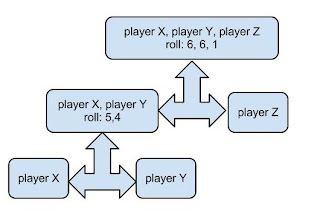
For example, we could have three players, X, Y, Z. If X and Y both rolled a 6 and Z rolled a 1, Z would be assigned the last spot and X and Y would roll again. If X got 5 and Y got 4 for their second rolls, the final order would be X, Y, Z. The follow diagram illustrates that example:

Looking back at it now, it seems to be like a tree expansion. Tree nodes would represent groups of players. For example, the root would be all unsorted players. Visiting the node would generate children by having each player roll their die. A child node of the root could be the players who tied the first round of rolls. Leaves would be players who did not tie. After all the nodes are expanded into leaves, an inorder traversal of the tree would result in the ranking.
from random import randint
from itertools import groupby

tree = [['player t', 'player u', 'player v', 'player w', 'player x', 'player y', 'player z']]
nextGeneration = []
keepPlaying = True
while keepPlaying:
    keepPlaying = False
    for node in tree:
        if len(node) == 1:
            nextGeneration.append(node)
        else:
            keepPlaying  = True
            rolls = [randint(1,6) for i in range(len(node))]
            turn = sorted(zip(rolls,node), reverse=True)
            print 'players roll:', turn
            for key, group in groupby(turn, lambda x: x[0]):
                nextGeneration.append(list(i[1] for i in group))
    tree = nextGeneration
    nextGeneration = []
print([item for sublist in tree for item in sublist])
If I recall correctly,this is what we wanted to do about 5 years ago in school. I don't see much use for it now though other than as an exercise in python. I need to think about how to test it more and make it more testable. A gui might help debug it and make what is happening clearer. At least I learned a little bit about groupby, sorted, zip, and list comprehensions.
Wednesday, May 25, 2011
Python Houdini Tool Post
Jasonfugh.com has a post of some video of a Python based special effects tool he made that works with Houdini. It is his first tool that he has made for Houdini. The software lives in a separate window to help change a rain effect in the main window.
Sunday, May 22, 2011

Sunday, May 08, 2011
Application in Python Using a Trie
I found a blog entry that describes using a Python implementation of a trie to calculate Levenshtein distance quickly but have yet to find the time to the sample code out. His implementation looks very readable and the concepts familiar. It seems like trying his software out could be a nice continuation of the concepts of the last project.
Subscribe to:
Posts (Atom)